
June 23, 2012


June 10, 2012
Iwagarami (Schizophragma hydrangeoides) flowers in Tokei-ji

In the garden of this temple, just before the rainy season, the small modest flowers of Iwagarami (which means "a plant that clings to a rock") bloom all together over the surfaces of rocks in the shade.
The inflorescence of this climbing plant has plenty of small bisexual flowers in its center and white ornamental flowers around these bisexual flowers.
Each of the ornamental flowers has an white petal-like calyx and a small degraded flower organ concealed in its base. This bright ornamental flower functions as a conspicuous sign for attracting flower-visiting insects.
Ayame (Iris sanguinea) flowers in Tokei-ji

Purple and violet are the dominant colors among the flowers of this rainy season.
The pale rainwater may cause these noble colors by mixing with the scarlet or red pigments of flowers.
The elegant but bizarre shape of an Iris flower has the purpose of skillfully putting pollen on the hairy bodies of the humble-bees which visit this flower.
Iwatabako (Schizophragma hydrangeoides) flowers in Tokei-ji

The small purple flowers of Iwatabako are eagerly extending beyond the wet rock surface in competition for inviting bumble-bees.
These star-shaped flowers seem to be the lovable fairies of the rainy season who kindly console us for the loss of a deep blue sky.
Iwagarami (Schizophragma hydrangeoides) flowers in Tokei-ji
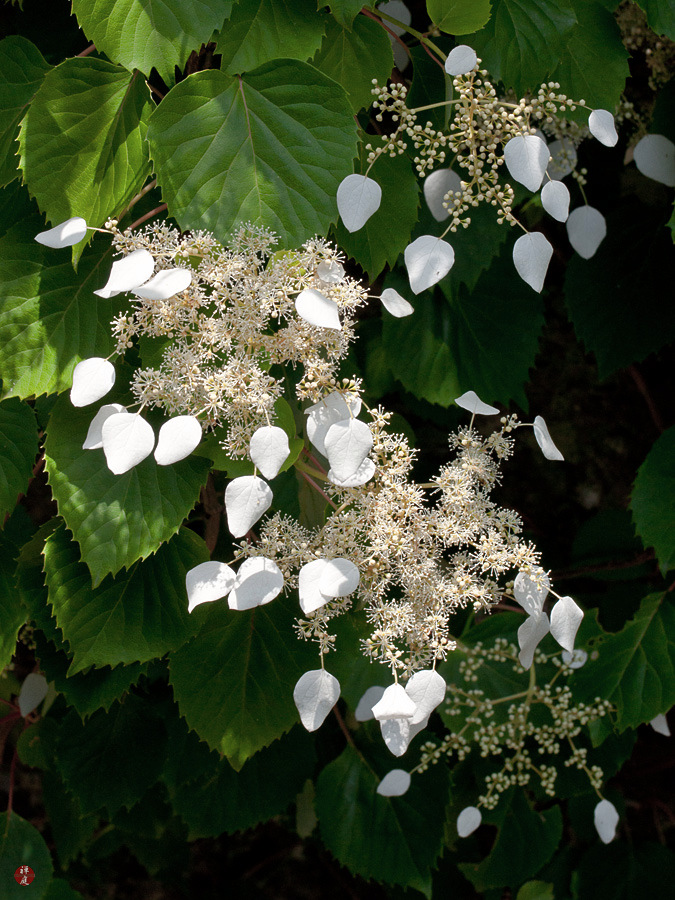
The white ornament flowers of Iwagarami are reflecting the pale sunlight of this rainy season brightly.
The light and shadow flowing down over the rock surface are finely adorning the modest and delicate beauty of Iwagarami flowers.
A Nami-ageha (Papilio xuthus) butterfly in Kita-kamakura

A butterfly, which seems to have hatched out from its cocoon, is quietly waiting for the moment of flying high in the sky.
The beautiful markings on its wings are harmonizing with the vivid violet flower to a miracle.
Iwatabako (Conandron ramondioides) flowers in Tokei-ji

The small pentacle flowers of the rainy season are staring us as if to try to let us know about the secret of the rain.
Gaku-ajisai (Hydrangea macrophylla) flowers in Tokei-ji

The rainy season has arrived.
The flowers of Ajisai, whose colors are enriched with the rainwater, begin to bloom.
May 30, 2012
Lotus leaves in Tsurugaoka-hachimangu

The numerous new leaves of lotus are rising to the calm water surface of the pond to prepare for its blooming season.
In the transparent morning sunlight, the water drops which the night rain left behind are shining clearly like precious amulet gems for these newborn leaves.
Soon summer must arrive here to let lotus bloom gloriously.
The garden of Chojyu-ji

The new leaves of hair-cap moss (Polytrichum juniperinum) , which densely cover this small garden, are growing vigorously and adorning this garden brightly with their fresh green.
The weathered rock encircled by the young leaves is basking in the vibrant sun of May joyfully.
The garden of Engaku-ji

The flowers of iris were blooming modestly along a grassy pathway in the pond garden.
A common bluebottle butterfly in Kaizo-ji

Under my eyes and paying no attention to me, a common bluebottle butterfly with intact and beautiful wings was flitting from flower to flower rejoicingly in search for nectar.
A stone image of Shokannon in Tokei-ji

A small stone image of Shokannon in the thicket was softly illuminated by a ray of sunshine coming down through the branches of trees.
Shokannon is one of the six Kannons (the Buddhist deities of mercy) and, as a manifestation of the infinite wisdom of Buddha, rescues all living things from Hell.
In the left hand of this Kannon, a lotus flower which is beginning to open is held as the symbol of his supreme wisdom.
Maple leaves in Tokei-ji

The beautiful gradation of greenness in new leaves is one of the most delightful gifts from this bright season.
The garden of Kaizo-ji

The various spring flowers which once delighted our eyes had already faded away.
In exchange for them, fresh green leaves are glittering brightly in the sun to make us perceive again the particular beauty of this vital season.
May 18, 2012
A Suiren (Nymphaea) flower in Kita-kamakura

Every flower speaks to us silently of the beauty of the universe where we live.
After the morning rain, this flower of water lily was decorated exquisitely with shining raindrops.
The floating flower of water lily opens in the morning and closes in the early evening for three days or so until its short life comes to end.
The name "Suiren" means "sleeping lotus" because its flower seems to wake up in the morning and fall asleep in the evening.
The spring grove of Tokei-ji

The fresh green leaves of an aged maple tree are sparkling delightedly in the crisp sunlight of May.
The greenness of the leaves is deepening with each passing day and will turn red and yellow at last before their falling in autumn.
This tree is standing still in this quiet grove like an old sage who knows the hidden truth of the changes of the seasons.
Haru-botan (Paeonia suffruticosa) flowers in Kencho-ji

The magnificent flowers of Haru-botan (spring peony) were blooming in the garden of the old Zen temple to triumphantly declare the true height of spring.
After the ending of these majestic flowers of spring, the gray rainy season approaches moment by moment.
Hime-utsugi (Deutzia gracilis) flowers in Engaku-ji

These small white flowers, which also let us know the peak of spring, are blooming discreetly and emitting faint aroma in every thicket here in Kita-kamakura.
In the clear morning light coming into the dense thicket, they seem to modestly express their heartfelt joy of flowering.
The spring grove of Tokei-ji

The new leaves filling this quiet grove dazzled our eyes with their beautiful and subtle gradation of greenness in the transparent sunlight peculiar to this season.
Subscribe to:
Posts (Atom)