Showing posts with label garden. Show all posts

November 2, 2025

The Sogen-chi Garden: Tenryu-ji (Kyoto)

The Sogen-chi Garden: Tenryu-ji (Kyoto)

Gentle autumnal breezes keep flowing lightly, ripples forming and fading on the calm pond's surface reflecting the surrounding trees, which have just begun to turn red and yellow. White clouds appear one after another in the clear blue sky, drifting away and vanishing in a moment. This ever-changing spectacle of stillness is making me find the beautiful metaphor of ”Mujo," namely, the absolute transience of our universe.

This Sogenchi (Sogen pond) garden was initially designed by Muso Soseki (1275-1351) to symbolize the realm of Shakyamuni Buddha's enlightenment, or the Buddha's pure land.

Muso Soseki was one of the most prominent masters of Zen Buddhism in Japan and was known also as a superior poet, calligrapher, and landscape gardener. He established the foundation for spiritual landscaping in Japanese garden culture. In other words, his approach to garden design sought not merely scenic beauty, but was intended to visualize the vivid image of enlightenment that Buddha experienced.

The vast central pond is called “Sogen Pond." This name is said to originate from the discovery of a stone monument inscribed with the words “Sogen Itteki Sui” (a single drop of Sogen) when Muso Soseki was dredging the pond during the garden's construction.

This is the Zen saying that means “the essence of Zen (Buddhahood) is as pure as a single drop of water, which flows through this world like a stream becoming a brook, a brook becoming a river, a river becoming a great river, and a great river becoming the ocean."


The Sogen-chi Garden: Tenryu-ji (Kyoto)

The Sogen-chi Garden: Tenryu-ji (Kyoto)

The Zen garden is not merely for appreciating its beauty but is the essential place for meditation as part of the spiritual practice of Zen Buddhism.

Monks keep sitting quietly on the floor of Hojo (main hall), devotedly gazing at the peaceful garden to silence their chattering minds and quietly observing their streams of boiling delusions to erase them completely.

To reach the transcendent awakening of Zen, "San-doku" (the three mental poisons that dirty the mind of man), that is to say, the burning desire, anger, and ignorance based on the survival instinct, must be washed away and inhibited. The path to spiritual enlightenment is fundamentally obstructed by the dirty delusions caused by these deadly poisons.

Viewing the garden with a calm mind is the daily practice of watching inward and "Sen-shin" (washing one's mind). Sen-shin means the washing away of San-doku to enter into nirvana and attain supreme enlightenment.

The tranquil garden of Tenryu-ji serves as a place for both appreciation and contemplation (spiritual cultivation). Gazing quietly at Sogen Pond from the Hojo, the peaceful view of Arashiyama and Kameyama mountains is integrated with the garden's glassy pond. Thus the nature, the garden, and the mind must shape the clear, visual appearance of the very essence of Zen Buddhism.


The Sogen-chi Garden: Tenryu-ji (Kyoto)

The Sogen-chi Garden: Tenryu-ji (Kyoto)

The Zen garden, or the garden for meditation, is the most important place within Zen Buddhist temples, which embodies the essence of practice, philosophy, and aesthetic sensibility of Zen.

The Zen garden symbolically expresses the truths of our nature and universe without any verbal explanation. Rather than realistically recreating the view of actual nature and the universe, it evokes enlightenment in the viewer's mind by visualizing the "Ku" (emptiness) and "Mujo" (the state of flux) by the use of water, stones, gravel, trees, plants, and so on.

The Zen term "Ku" refers to the fundamental Buddhist concept that all things lack a fixed, inherent essence and are void, like just a fleeting day-dream. Because of our ignorance, we always fail to notice this truth. Our universe keeps arising and vanishing in a flash through the infinite interconnection between cause and effect.

The Zen garden serves as a place for “contemplation” (Kanso) during practice. Monks sit in the Hojo (the main hall), gaze at the garden, and silence their minds completely to shut out idle thoughts from their minds. Because thinking is the source of any delusion that hinders us from a spiritual awakening.

This allows them to intuit the deep movements of their mind and train themselves to attain a pure state of "Muga" (the perfect selflessness) away from all noisy thoughts.

The Zen garden is the intermediate gate that connects our earthy world (the human realm) and Nirvana (the realm of supreme enlightenment).  Passing through this gate, practitioners can detach from the stained delusions of daily life and enter into the purified land of mind that Buddha taught.


The Sogen-chi Garden: Tenryu-ji (Kyoto)

The Sogen-chi Garden: Tenryu-ji (Kyoto)


The Sogen-chi Garden: Tenryu-ji (Kyoto)

The Sogen-chi Garden: Tenryu-ji (Kyoto)


The Sogen-chi Garden: Tenryu-ji (Kyoto)

The Sogen-chi Garden: Tenryu-ji (Kyoto)


The Sogen-chi Garden: Tenryu-ji (Kyoto)

The Sogen-chi Garden: Tenryu-ji (Kyoto)


The Sogen-chi Garden: Tenryu-ji (Kyoto)

The Sogen-chi Garden: Tenryu-ji (Kyoto)


The Sogen-chi Garden: Tenryu-ji (Kyoto)

The Sogen-chi Garden: Tenryu-ji (Kyoto)


Sanzon-seki Garden of "Hogon-in" sub-temple:Tenryu-ji (Kyoto)

Sanzon-seki Garden of "Hogon-in" sub-temple:Tenryu-ji (Kyoto)


Garden of "Hogon-in" sub-temple:Tenryu-ji (Kyoto)

Garden of "Hogon-in" sub-temple:Tenryu-ji (Kyoto)


July 2, 2025

Kakitsubata (Iris) flowers: Garden of Nezu Museam (Tokyo)

Kakitsubata (Iris) flowers: Garden of Nezu Museam (Tokyo)

 In May of this year, I visited Nezu Museum (Minato-ku,Tokyo) to appreciate the three greatest pictures of the Rinpa School, namely, Korin Ogata's national treasure picture “Kakitsubata-hana-zu (rabbit-ear-iris flowers picture),” Okyo Maruyama's picture “Fuji-hana-zu (wisteria flowers picture),” and Kiichi Suzuki's picture “Natsu-aki-keiryu-zu (mountain stream in summer and autumn)" in the special exhibition celebrating the 85th anniversary of this honorary private museum.

(Please refer to the links for each of the paintings on the official web site of this museum.)

After viewing the exhibition, I wandered through the verdant Japanese garden attached to the museum. At the end of the intricate walking path, I suddenly found numerous ultramarine-blue flowers of Kakitubata blooming brightly in the dazzling sunlight of May in the central garden pond, which gave me an unexpected pleasure as a bolt from the blue. 


Kakitsubata (Iris) flowers: Garden of Nezu Museam (Tokyo)

Kakitsubata (Iris) flowers: Garden of Nezu-museam (Tokyo)


February 5, 2024

Huyu-botan (winter peony) and Taihu stones : Tsurugaoka-hachimangu

Huyu-botan (winter peony) and Taihu stones : Tsurugaoka-hachimangu


The typical flowering season of peonies is early summer. But, in the cold mid-winter, when the beautiful colors of flowers can be hardly found in gardens, the colorful flowers of Huyu-botan (winter peony) are made to bloom artificially and displayed to delight the eyes of flower fanciers.

These delicate flowers are very vulnerable to harsh winter weather and are affectionately sheltered in straw-covers to protect them against the coldness and dryness of winter.

Taihu stones are oddly-shaped stones with many holes and have been cut out of the hills around Lake Taihu, near Suzhou, China. 

These stones have been highly prized as the traditional garden stones in China. They are placed in the renowned gardens in Suzhou and other parts of China for appreciation and meditation.

The hills around Lake Taihu and the islands in the lake are made of pale limestone, and the long erosion by lake water has created many holes in the limestone, giving it complex and tasteful shapes like modern sculpures.

I don't know by what strange connection these winter peonies and Taihu stones are arranged in this garden, but it is certainly a very rare and beautiful garden scene in the deep of winter.


October 28, 2022

Shokin-tei teahouse and pond garden: Katsura-rikyu (Kyoto)

Shokin-tei teahouse and pond garden: Katsura-rikyu (Kyoto)


About the middle of this September, I visited Katsura Imperial Villa (located in Kyoto City, under the jurisdiction of the Imperial Household Agency), which is esteemed as one of the most exquisite examples of Japanese classic architecture and garden design. I was given a guided tour by the Imperial Household Agency, which lasted only one hour, to look around the pond-garden, the teahouses and the private Buddhist-hall scattered along the pond.

Unfortunately, due to the guiding policy of the Imperial Household Agency which is in charge of managing the facilities, it was not allowed to see the celebrated interior of the main palaces such as the Study halls, the reception hall and so on. The architectural designs, furnitures and interior decorations of these palaces are the highlights of this excellent villa.

The palaces and garden in the present form were completed in 1645 as the residence for the Katsura Family, members of Japan's Imperial Family.

The riverside area of the Katsura-gawa River, where this villa is located, was known for the noted place for moon-watching. There is a shrine called Tsukiyomi Shrine (moonlit-night-viewing shrine) near this villa, and the name "Katsura" is said to be derived from the Chinese word for "moon-viewing." 

Katsura Imperial Villa, located in such a location, was basically designed to be a place for viewing the beautiful moon. It also served as a aristocratic place for various entertainments and events, such as boating on the pond, tea ceremonies at its teahouses scattered around the pond-garden, and banquets, in addition to enjoying the moonlight.


The view of pond garden from Shokin-tei teahouse: Katsura-rikyu (kyoto)

The view of pond garden from Shokin-tei teahouse: Katsura-rikyu (kyoto)


The view of pond garden from Shokin-tei teahouse: Katsura-rikyu (kyoto)

The view of pond garden from Shokin-tei teahouse: Katsura-rikyu (kyoto)


April 3, 2022

Spring garden: Jochi-ji

Spring garden: Jochi-ji


In the small humble garden where seasonal plants and trees grow as they naturally are, I found a flower assortment of yellow-mitsumata, white apricot, and pink peach, which represented the incoming of spring in Kita-kamakura.


The bright yellow flowers are yellow-mitsumata. Its bundles of cottony flower-buds sprout in the form of a tiny toy handball in the beginning of February, and keep growing quietly in the height of the harsh season. 


Around the middle of March, as the warmth and sunlight of spring increase, these small yellow buds begin to bloom all together like dear children smiling joyfully and to emit a pleasant aroma, quietly heralding the arrival of long-expected spring.


December 19, 2021

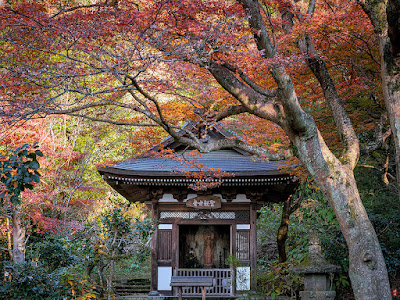
Autumn leaves in the garden of Obai-in (Engaku-ji)

Autumn leaves in the garden of Obai-in (Engaku-ji)


The colorful autumn-leaves, which are past their prime and have begun to dry up, are continuing to scatter and fall one after another in the cutting north-wind. Before I visit this quiet garden next time, these leaves will have disappeared from view completely.

Sensing the subtle transition of the seasons, living things continue to change their lives every moment according to their cycles of birth, death and rebirth. 

The deciduous trees, which have worn thick greens, shed all their died leaves to endure the winter and secretly prepare for regrowth in the next spring.

Under the eyes of the small wooden statue of Sho-Kannon, the endless cycle of death and rebirth keeps turning silently without being known to anyone.